
How Long Does Tretinoin Take to Work? A Realistic Timeline
Tretinoin does not work overnight. How quickly you notice a change depends on why you are using it, your strength, how often you apply it and how well your skin tolerates treatment.
For acne, treatment is generally assessed over a 12-week course rather than after only a few days or weeks. For photoageing and pigmentation, published studies show that improvement continues over several months and can continue with longer-term treatment.
Quick Answer
There is no single week when tretinoin suddenly “starts working”. Acne treatment is commonly reviewed after around 12 weeks, while improvements in texture, fine lines and uneven pigmentation may continue to build over several months. Early irritation can occur before visible benefit.
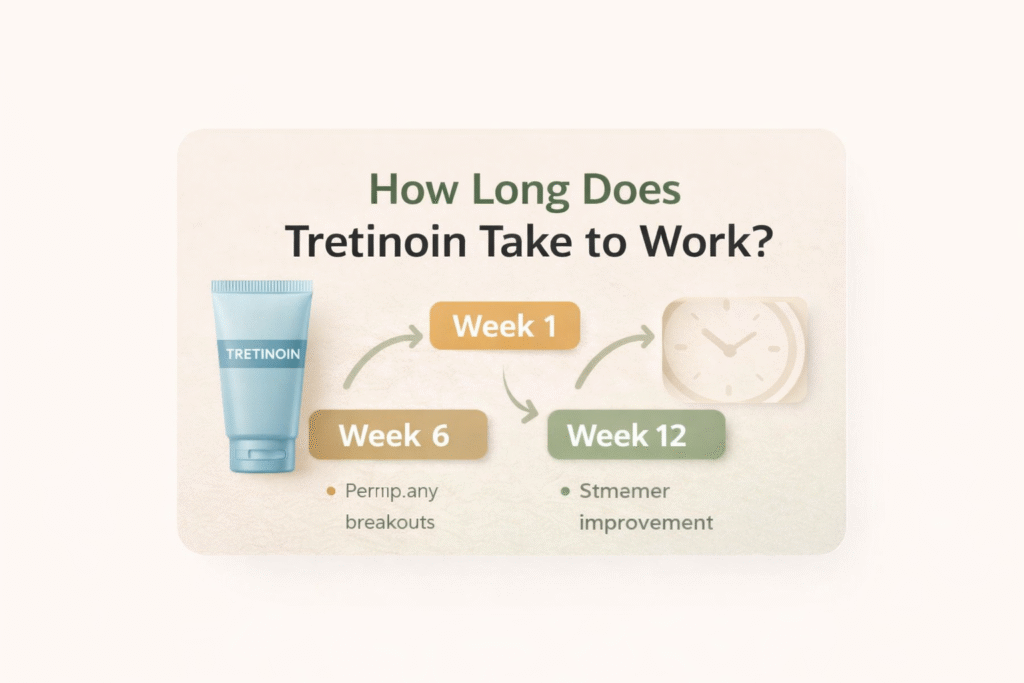
Tretinoin Timeline: What to Expect
Why Does Tretinoin Take Time to Work?
Tretinoin is a topical retinoid. In acne, it helps normalise follicular cell turnover and reduce microcomedone formation. Retinoid-related changes in the epidermis happen progressively rather than after a single application.
In photoaged skin, clinical trials have also shown progressive changes in roughness, mottled pigmentation and fine wrinkling over months of use.
Visible results and biological activity are not the same thing
Tretinoin begins affecting retinoid-responsive pathways before you can necessarily see a cosmetic difference. This is why early treatment should be judged by tolerability and the overall trend rather than expecting immediate visible results.
How Long Does Tretinoin Take to Work for Acne?
NICE acne guidance recommends assessing first-line acne treatment over a 12-week course. That does not mean every person will be clear at 12 weeks, but it is a more useful treatment window than expecting a result after one or two weeks.
Early treatment
The first weeks may be dominated by dryness or irritation rather than visible improvement. NICE advises that topical retinoids can initially be introduced on alternate days or using short-contact application to reduce irritation.
Around 12 weeks
This is a sensible point for a broader review of acne response, adherence and tolerability. If improvement is inadequate, the treatment plan may need reassessment rather than simply increasing strength.
How Long Does Tretinoin Take to Work for Fine Lines and Photoageing?
Photoageing tends to require a longer horizon than acne. Randomised clinical studies of topical tretinoin have shown improvements in fine wrinkling, mottled pigmentation, roughness and other signs of photodamage over approximately 24 weeks.
Longer-term studies have found that improvement can continue or be maintained beyond this point with sustained treatment.
Think in months, not days
If your main goal is skin texture, fine lines or photodamage, judging tretinoin after only a few weeks is usually too early. Long-term consistency and tolerability matter more than trying to force rapid results.
How Long Does Tretinoin Take to Work for Pigmentation?
Pigmentation is not a single diagnosis, and the expected timeline depends on the underlying cause. Published photoageing studies have shown progressive improvement in mottled hyperpigmentation over several months, but this should not be interpreted as a guaranteed timeline for every pigmentary condition.
Sun protection is especially important because UV exposure can worsen uneven pigmentation and undermine progress.
Does Tretinoin Cause Purging?
Some people report an initial increase in breakouts after starting a topical retinoid, but a “purge” is not inevitable and there is no reliable rule that it must occur or must finish by a particular week.
New acne, irritation, rash or worsening skin should not automatically be dismissed as purging. If symptoms are severe, persistent or outside the areas where you normally break out, speak to your prescriber.
What Affects How Quickly Tretinoin Works?
Your treatment goal
Acne, texture, pigmentation and photoageing do not all improve on identical timelines.
Strength and formulation
Higher concentration can increase irritation and is not automatically a faster or better route for every person.
Application frequency
A regimen you can use consistently may be more useful than an aggressive schedule that repeatedly causes irritation.
Skin tolerance
Dryness, peeling and redness can interrupt treatment if the skin is pushed too quickly.
Your wider skincare routine
Harsh exfoliants or multiple irritating active ingredients can make tretinoin more difficult to tolerate.
Sun protection
A sensible sunscreen routine is particularly important when pigmentation or photoageing is part of the treatment goal.
How to Improve Tretinoin Tolerability
Trying to make tretinoin work “faster” by applying more product or using it more frequently than advised can increase irritation without guaranteeing better results.
Introduce treatment gradually
NICE specifically advises alternate-day or short-contact use when introducing topical retinoids if needed to reduce irritation.
Use the prescribed amount
More product does not mean faster results. Follow the directions supplied with your formulation.
Use moisturiser
A simple moisturising routine can help support tolerability during the adjustment phase.
Keep the routine simple
Avoid adding several new potentially irritating actives at the same time unless your treatment plan specifically requires them.
When Should You Contact Your Prescriber?
Get advice if treatment is not going as expected
- Severe or persistent burning, swelling or skin pain
- Marked cracking, blistering or significant dermatitis
- Worsening acne that is severe or concerning
- No meaningful improvement after an appropriate treatment period
- You become pregnant or plan a pregnancy while using a topical retinoid
NICE states that topical retinoids are contraindicated during pregnancy and when planning a pregnancy.
Ready to Explore Tretinoin?
Root & Radiance provides 0.025%, 0.05% and 0.1% tretinoin pathways. The strength you request is reviewed for clinical suitability before prescription-only treatment is supplied.
Explore Related Tretinoin Guides
How Long Does Tretinoin Take to Work? FAQs
How long does tretinoin take to work for acne?
Acne treatment is commonly assessed over a 12-week course rather than after only a few weeks. Individual response varies, and some people need a longer-term treatment plan.
When should I expect visible tretinoin results?
Visible results depend on the treatment goal. Acne may be assessed over around 12 weeks, while changes in photoageing, fine lines and pigmentation can continue to build over several months.
Does tretinoin always cause purging?
No. Not everyone experiences an initial flare in breakouts. New or worsening symptoms should not automatically be assumed to be a normal purge.
Can I use tretinoin every night?
Some people tolerate regular nightly use, while others need a slower introduction. NICE advises alternate-day or short-contact application when needed to reduce irritation before progressing to standard use.
Does stronger tretinoin work faster?
Not necessarily. Higher concentration can increase irritation and may make consistent treatment harder. The appropriate strength depends on previous retinoid use, skin tolerance and prescriber assessment.
How long does tretinoin take to work for wrinkles?
Published studies of topical tretinoin for photodamaged skin have shown significant improvement over about 24 weeks, with longer-term studies showing continued or sustained benefit with ongoing use.
How long does tretinoin take to work for pigmentation?
The timeline depends on the underlying pigmentation problem. Clinical studies in photodamaged skin have shown progressive improvement in mottled pigmentation over several months.
What if tretinoin is not working after 3 months?
For acne, around 12 weeks is a useful review point. If there is little improvement, significant irritation or uncertainty about the diagnosis, speak with your prescriber rather than simply increasing the strength yourself.