
How to Use Tretinoin Properly: A Beginner’s Night Routine
Learning how to use tretinoin correctly is mostly about consistency and tolerability. Use the amount and frequency directed for your prescription, apply it to clean skin as instructed, moisturise if needed, and avoid trying to speed up results by using more product.
This practical UK guide covers how to apply tretinoin, how much to use, when to moisturise, how often beginners may be advised to start, what to avoid and when irritation needs review.
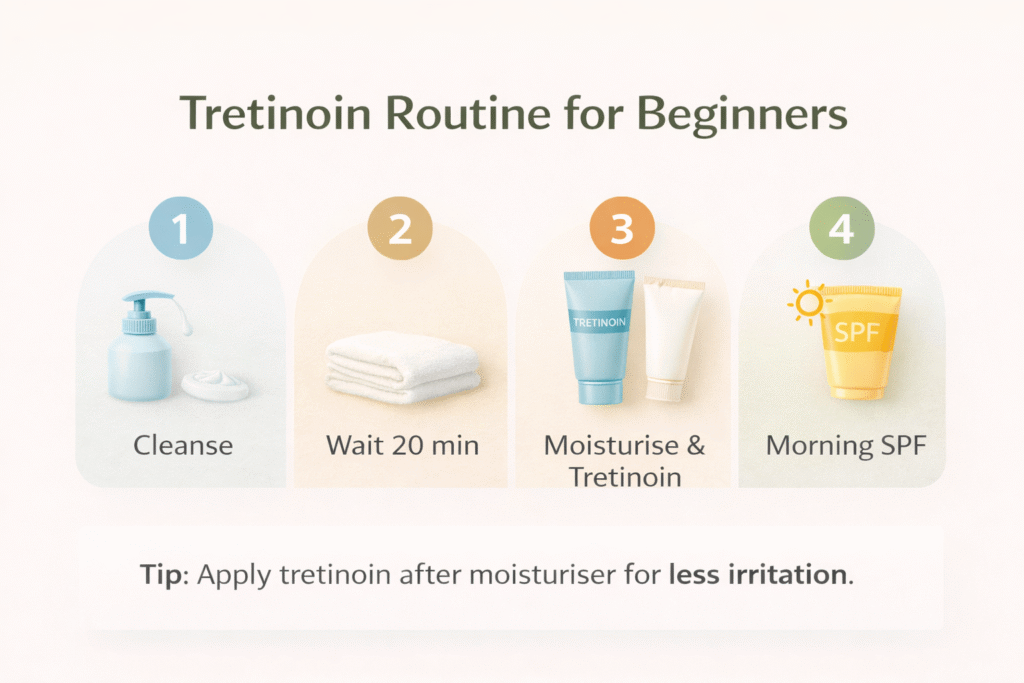
Gentle cleanse → allow skin to dry → apply the prescribed amount → moisturise as needed → keep the rest of the routine simple. Your individual prescription directions take priority over any general routine online.
How to Apply Tretinoin at Night
Cleanse gently
Wash the treatment area with a mild cleanser and avoid aggressive scrubbing. Starting with an already irritated skin barrier can make a topical retinoid harder to tolerate.
Allow the skin to dry
Pat the skin dry rather than rubbing it. Follow the application instructions supplied with your prescription. The aim is clean, dry skin without unnecessary friction or irritation.
Apply the prescribed amount in a thin layer
Spread the medicine thinly over the area you have been instructed to treat and avoid the eyes, lips and other sensitive areas unless specifically directed otherwise. Do not apply extra product in an attempt to make tretinoin work faster.
Moisturise if needed
A simple moisturiser can help manage dryness and improve tolerability. Some people prefer moisturiser after tretinoin, while people who are particularly irritation-prone may be advised to use moisturiser before and/or after treatment.
Leave the rest of the night routine simple
Avoid introducing several potentially irritating products at once. A routine that your skin can tolerate consistently is usually more useful than an aggressive routine that repeatedly has to be stopped.
Use the quantity stated on your prescription label or treatment instructions. As a useful licensed-product reference, Treclin 1%/0.025% gel instructs patients to use a pea-sized amount for the entire face once daily at bedtime. Your own compounded tretinoin directions may differ, so follow the instructions supplied with your prescription.
How Often Should You Use Tretinoin?
There is no universal beginner timetable that everyone must follow. Frequency should reflect your prescription, previous retinoid use and how your skin responds.
For acne, NICE advises that topical retinoids can be introduced using alternate-day or short-contact application to reduce irritation, then progressed to standard application if tolerated.
Should Tretinoin Go Before or After Moisturiser?
If your prescription directs application to clean, dry skin, that remains the default. Moisturiser can then be used to support the skin barrier and manage dryness.
Tretinoin then moisturiser
This keeps the medicine directly on clean, dry skin and adds moisturiser afterwards to help with dryness and tightness.
The “sandwich” approach
Some irritation-prone users apply moisturiser before and after the retinoid. This is a tolerability strategy rather than a rule everyone needs to follow. Ask your prescriber if you are unsure whether it is appropriate for your formulation.
A Simple Tretinoin Skincare Routine
Morning
- Gentle cleanse or rinse
- Moisturiser if needed
- Broad-spectrum sunscreen and sensible sun protection
Sun protection is particularly important when treating pigmentation or photoageing and helps protect skin that may already be irritated.
Evening
- Gentle cleanse
- Allow skin to dry
- Apply tretinoin as prescribed
- Moisturise as needed
- Avoid unnecessary irritating actives
If your own prescription directions differ, follow those directions rather than this general example.
What Should You Avoid When Starting Tretinoin?
The biggest beginner mistake is often making the entire skincare routine more aggressive at the same time as introducing tretinoin.
Scrubs and over-exfoliation
Physical scrubs, strong exfoliating cleansers and excessive acid use can add to irritation when your skin is already adjusting to a retinoid.
Other retinoids
Do not automatically layer cosmetic retinol or retinal on top of prescription tretinoin. This usually adds irritation without a clear reason.
Benzoyl peroxide
Do not assume benzoyl peroxide can never be used in the same overall treatment plan. Timing and formulation matter. If both are part of your regimen, follow the directions given by your prescriber.
Waxing or irritated skin
Avoid applying tretinoin onto broken, sunburnt or significantly irritated skin. Ask for advice around cosmetic procedures if you are unsure when treatment should be paused.
Does Your Face Need to Be Completely Dry?
Clean, dry skin is a common direction for topical retinoid products. You do not need to follow an arbitrary online rule that everyone must wait exactly 15 or 20 minutes.
If your skin remains damp immediately after washing, allow it to dry before application. If your prescription gives a specific waiting period, follow that instruction.
The important instruction is to follow the product or prescription directions and apply to clean, dry skin where directed. A universal 15 to 20 minute waiting period is not necessary to present as a fixed rule for every tretinoin formulation.
Which Tretinoin Strength Should a Beginner Use?
There is no single concentration that every beginner should use. The appropriate strength depends on the condition being treated, previous retinoid exposure, skin sensitivity, other products being used and the prescriber’s assessment.
Root & Radiance offers pathways for 0.025%, 0.05% and 0.1% tretinoin. Requesting a particular strength does not guarantee that it will be prescribed. Clinical suitability is reviewed before prescription-only treatment is supplied.
Is Tretinoin Purging Normal?
Some people report an early flare in acne after starting a topical retinoid, but not everyone purges and there is no reliable rule that every flare must settle by a particular week.
Redness, dryness, burning, dermatitis and worsening acne can also represent irritation or another problem. Do not automatically label severe or persistent symptoms as “purging”.
When Should You Reduce Frequency or Get Advice?
Mild dryness or irritation can occur with topical retinoids. If irritation becomes significant, reducing frequency or temporarily interrupting treatment may be appropriate depending on your prescription and clinical advice.
you develop severe or persistent burning, marked swelling, blistering, significant dermatitis, symptoms that do not improve after reducing irritation triggers, or you are unsure whether the reaction is expected.
Topical retinoids are contraindicated during pregnancy and when planning a pregnancy. If you become pregnant while using tretinoin, stop using it and contact your healthcare professional for advice.
Explore Tretinoin in the UK
View the 0.025%, 0.05% and 0.1% tretinoin pathways and complete an online clinical consultation. Prescription-only treatment is supplied only where clinically appropriate following prescriber review.
Related Tretinoin Guides
How to Use Tretinoin: Frequently Asked Questions
How do I use tretinoin correctly?
Follow the directions supplied with your prescription. A typical routine involves gentle cleansing, allowing the skin to dry, applying the prescribed amount in a thin layer to the treatment area, and using moisturiser as needed.
Should I apply tretinoin before or after moisturiser?
If your prescription directs application to clean, dry skin, tretinoin can be applied before moisturiser. Some irritation-prone users may be advised to use moisturiser before and/or after treatment. Follow the directions for your formulation.
How much tretinoin should I use?
Use the amount stated in your prescription directions. Applying extra does not make treatment work faster and can increase irritation. As a licensed-product reference, Treclin gel uses a pea-sized amount for the entire face.
How often should a beginner use tretinoin?
There is no universal schedule for every beginner. NICE advises that topical retinoids can be introduced with alternate-day or short-contact application when needed to reduce irritation, before progressing to standard application if tolerated.
Do I have to wait 20 minutes before applying tretinoin?
No universal 20-minute rule applies to every formulation. Follow your prescription directions and apply to clean, dry skin where instructed. If the skin is still damp after cleansing, allow it to dry before application.
Can I use tretinoin every night?
Some prescribed regimens use once-daily evening application, but whether that is appropriate for you depends on the formulation, condition being treated and tolerability. Do not increase frequency beyond your directions simply to speed up results.
Can I use benzoyl peroxide with tretinoin?
They can form part of the same acne treatment plan in some circumstances, but timing and formulation matter. Follow your prescriber’s instructions rather than automatically layering them together.
Do I need sunscreen while using tretinoin?
Sensible sun protection is recommended, particularly because irritated skin may be less tolerant of sun exposure and because UV exposure can undermine treatment goals such as improving pigmentation or photoageing.
Can I use tretinoin during pregnancy?
No. NICE states that topical retinoids are contraindicated during pregnancy and when planning a pregnancy.
What should I do if tretinoin makes my skin very irritated?
Do not simply push through severe irritation. Reduce other irritation triggers and seek advice about whether frequency should be reduced or treatment temporarily paused. Severe or persistent reactions should be reviewed by your prescriber.